Friday, April 13, 2012

The 4 R's - Nutrient Stewardship

If you have been paying attention to nutrient management in agriculture over the past few years then you have likely heard about "the 4 R's". 
Right fertilizer source at the..... Right rate, at the.... Right time and in the..... Right place.

State of the art devices help farmers to monitor nutrient applications.

This is a simple way that reminds us that appropriate utilization of nutrients such as nitrogen, phosphorus, and potassium is more complex than simply how many pounds per acre were applied.  Nutrient management can be a real challenge in agriculture, homeowners, golf courses, any type of entity managing open lands due to weather and climate fluctuations, soil variability, and environmental/social sensitivities.  


Soil nutrient needs are tested and mapped;
this aids with application recommendations.
This is a really important issue that is regularly misunderstood.  Nutrient management is complex and is difficult to summarize into simple soundbytes and requires years of experience to properly implement.  Let's take nitrogen for example, nitrogen changes molecular forms regularly in nature and some forms are what plants(corn, lawn grass, trees, etc.) want, some not; some forms of nitrogen turn into gas easily and simply become part of our air and many forms easily move whereever the water flows.  Tricky isn't it? 
So.....how efficiently nitrogen is utilized in nature, on your lawn, and in the farm field depends on your ability to predict the weather (meteorologist anyone?), determine if your vegetation/plants are/will be at a stage which they need nitrogen (agronomist/plant biochemist anyone?), and what form would be best to select for application based on those previous factors (yikes!).  Did I mention that nitrogen is expensive, so you really don't want to get this wrong or it will be painful on the pocketbook!  And of course an over-abundance nitrogen in our aquatic ecosystems can be detrimental in many ways too.  Lastly, in agriculture without the addition of vital nutrients, crop yields would be poor and declining, leading to serious food security concerns in the future.       
 
Here are more details about the 4 R's nutrient stewardship initiative:  The Fertilizer Institute (TFI) has been working collaboratively with the International Plant Nutrition Institute (IPNI), the International Fertilizer Industry Association and the Canadian Fertilizer Institute (CFI) to advance the 4R nutrient stewardship initiative. Two goals within the initiative include establishing 4Rs as a recognizable strategy for economic, social, and environmental sustainability and expanding the adoption of 4R nutrient stewardship as well as the awareness of these efforts to federal and state program officials.


Some conservation best management practices that Todd Welch, a 4 R's Advocate from Lafayette, IN utilizes on his farm to better ensure efficient use of nutrients.


• Utilize grid soil samples to create management zones
• Use manure nutrients from the hog operation to meet a fraction of fertilizer needs by applying to acres most in need of P and K
• Utilize Phytase in feed rations to improve phosphorus efficiency in the animal diet
• Utilize amendment to increase availability of P and K throughout the crop year
• Account for manure nutrients and adjust levels of commercial fertilizer to meet remainder of plants’ needs
• Utilize variable rate technology to apply commercial fertilizer
• Split apply nitrogen in fall and spring to reduce losses
• Incorporate nitrogen stabilizer with fall ammonia application to reduce losses
• Utilize in-season tissue sampling to obtain a snapshot of plant nutrient needs
• Utilize post-season stalk tests to evaluate nitrogen utilization
• Implement minimum tillage to help build and maintain organic residue
• Plant cover crops to generate organic matter, improve soil tilth, reduce compaction and improve
nitrogen management
• Enhance water management through utilization of waterways and tile control
• Install a precision planter system for better seed placement and spacing


What Todd says about the 4Rs: “Our farming operation firmly believes that the proper use of organic and commercial fertilizer is not only vital to our operation, but also economical and environmentally friendly to our natural resources”.

Thursday, March 22, 2012

Cover Crop Root Dig

Guest post by Logan Garner:  
Logan Garner is a graduate of Butler University with a B.A. in Science and Technology Societal Studies with a focus on environmental policy.  At Butler University he worked for the biology department and wrote and edited for the Butler Science Magazine.  Before joining the ISDA Logan worked in agricultural research and development at Dow AgroSciences on herbicide development and soil degradation studies.  He is a resource specialist for the Tippecanoe River Watershed and is located in Warsaw, IN at the Kosciusko County SWCD office. 


I visited my first cover crop root dig this week.  On an unseasonably warm March morning I arrived at a dig just south of Huntington to join a convoy of trucks and SUVs parked on the shoulder of state road 5.  Ag owners and operators, Indiana State Department of Agriculture (ISDA), Soil and Water Conservation District (SWCD) staff  and Natural Resource Conservation Service (NRCS) personnel and a sprinkling of Cisco seed reps made up the small crowd of thirty or so folks enjoying coffee and donuts on the side of the road…I think the refreshments may have attracted a few stragglers as well.  At any rate, it wasn’t long before Scott Haley, an NRCS soil scientist, introduced himself and one Dave Robison from Cisco Seeds.  He then hailed everyone to the first root pit—or rectangular hole in the ground as it appears.  


As an introduction, the presenters highlighted gains to soil health and water quality as well as the logistic and economic benefits that generally accompany a field in a no-till/cover crop regimen.  Farmers chimed in opinions and shared experiences while county, state and federal staff gave their two cents as well.
Dave Robison took things from there, discussing the strengths and weaknesses of each cover crop species as well as their useful mixes and pairings.  

As the morning progressed we moved from one pit to the next.  Terms like “nodules”,” nutrient management”,” tilth”, “water retention” and “biotic function” arose as the familiar buzzwords of the day; rye grass, crimson clover, hairy vetch, cowpeas, radishes and oats were the species in evidence.  For a seasoned cover crop academic, the event was both a refresher and a discussion board.  To fledgling land owners and operators of the cover crop world it was an introductory course in soil health conservation farming.  For newer employees like me it was a great opportunity to pick apart the dos and don’ts of management, species selection and rotation.


After all the pits were examined and the roots and soil clods were passed around the crowd for examination, a brief Q&A drew the field event closer to an end. The only thing left was the infamous soil demonstration, wherein we see the difference between bacterial driven soil systems (tilled soil) and fungal driven systems (no till/cover crops). I’d seen this demonstration nearly a dozen times so far in my less than three months with ISDA. But just when I thought I could give the presentation myself, I learned something new and important yet again. As I listened and watched Scot Haley drop two dried samples of soil into glass cylinders of water, an unfamiliar word (that I’ve somehow missed all this time…don’t judge me) escaped his lips: GLOMALIN!! Glomalin-related soil proteins are a significant component of soil organic matter and act to bind mineral particles together, improving soil quality.
 

For more information on Cover Crops, check out the Conservation Cropping Systems Initiative (CCSI) website


Wednesday, February 1, 2012

Dig It.....Soil Secrets

I left you last time with I "Heart" Soil as the theme borrowed from our friends at the Soil Scientist Society of America .  I felt as though is is only fitting that I follow up with some more of those reasons why I love soil and why everyone must have a deeper understanding and fondness of this critical resource.  I've heard it said many times that soil is the Rodney Dangerfield of the natural resources, because it gets no respect.  Well I'm sharing some information here to drive home why soil deserves our utmost respect! 

I have "borrowed" this information from the National Association of Conservation Districts who have done an excellent job of educating the public about natural resources.  These are excerpts from their highly-regarded "Dig It, The Secrets of Soil" education campaign.  Indiana's own, Susan Schultz, does an excellent job coordinating these efforts for NACD.

Is soil an important ingredient in your every day life?

- The answer is yes, and here are a few reasons why:


Last night you slept in a building built on soil.


You drink water that flows through soil and is cleaned by the soil.


You breathe air that comes partly from plants growing in the soil.


You even wear clothes made from plants that grow in the soil.


Soils make our lives possible. We build on them, play on them, drive on them, eat food grown in or raised on them, take medicines from them, wear clothes we wouldn’t have without soils, drink water that wouldn’t be clean without soils, breathe air we wouldn’t have without the plants and trees growing in soils. The entire earth—every ecosystem, every living organism—is dependent upon soils.


A Few Facts about Soil


-Soil makes up the outermost layer of our planet.


-Topsoil is the most productive soil layer.


-Soil has varying amounts of organic matter (living and dead organisms), minerals and nutrients.


-Five tons of topsoil spread over an acre is only as thick as a dime.


-Natural processes can take more than 500 years to form one inch of topsoil.


-Soil scientists have identified over 70,000 kinds of soil in the United States.


-Soil is formed from rocks and decaying plants and animals.


-An average soil sample is 45 percent minerals, 25 percent water, 25 percent air and five percent organic matter.


-Different-sized mineral particles, such as sand, silt, and clay, give soil its texture.


-Fungi and bacteria help break down organic matter in the soil.


-Plant roots and lichens break up rocks which become part of new soil.


-Roots loosen the soil, allowing oxygen to penetrate. This benefits animals living in the soil.


-Roots hold soil together and help prevent erosion.


Information provided by U.S. Dept. of Agriculture, Natural Resources Conservation Service and listed on the Environmental Protection Agency website at http://epa.gov/gmpo/edresources/soil.html.


There are some great materials on the NACD website and much more information about Soil and Water Conservation Districts.  Stay tuned for more soil information in the future including NACD's next campaign which is Soil to Spoon!


Tuesday, December 13, 2011

I Heart Soil


SSSA
I really do love soil and the folks that I work with in agriculture and conservation do too.  We love it because we have the opportunity to see everyday what a precious resource that it is.    We get to see the passion for conservation, productive lands, clean waters, wildlife, the Aldo Leopold "Land Ethic" in full swing!  In fact, everyone experiences the impact that soil has on our lives everyday through the food we eat, water we drink, home where we live, etc.  It is an awesome thing!

Another awesome thing.......the Soil Science Society of America has made these really cool, simple videos about the importance of healthy soil and the connection to clean water and food.  You can learn more at iheartsoil.org  .
Check out these cool videos by clicking the links below....I Heart Soil


Healthy Soil = Healthy Water
Healthy Soil = Healthy Food


Yet another awesome thing.......Our 2011 Indiana Tillage Transect results tell us that approximately 180,000 acres of Hoosier farmland is planted  to Cover Crops this year.  So, we have several farmers out there around Indiana working to build their soil quality, trying to hang on to their precious nutrients and topsoil, and keeping that beneficial soil biological activity humming all year long.  Good chance that if paired with no-till, they could be rewarded in any or all of the following....yield gains, better drought tolerance, minimized ponding, fuel savings, and on and on and on. 


Friday, November 4, 2011

Cover Crops, Airplanes, and Indiana Conservation Districts!


I am holding a big tillage radish planted this fall in Gibson County.
Indiana Agriculture Director, Joe Kelsay, and I, along with our conservation partners recently had the opportunity to visit with the Warrick, Posey, Vanderburgh, and Gibson County Soil and Water Conservation Districts to learn about a successful project they have worked on for the past 3 years.  This projects' objectives center around increasing the amount of cover crops utilized in these 4 counties.  They do this by coordinating aerial seeding application with local farmers and they provide cost-share for them to participate.  Here is an article written in the local paper explaining this project and for more information on cover crops visit Midwest Cover Crops Council....
  
Soil, water conservation partnership spotlighted
By JANICE BARNIAK
janice@pdclarion.com


PRINCETON — Four local soil and water conservation districts were recognized Thursday for a joint partnership that they say has made southern Indiana water cleaner, soil healthier for crops, and created habitats for local wildlife through the winter.
    The initiative began when Gibson, Posey, Vanderburgh and Warrick Counties banded together to apply for a grant to support a cover crop program, said Travis Gogal NRCS District Conservationist for Gibson County.
    Cover crops are important to soil health, Gogal said, because planting a cover crop feeds microbes that keep the soil alive and make nutrients readily available for crops. Better soil means better, cleaner water, and the crops help local animals have a habitat throughout the winter.
    According to Gary Seibert, of Fort Branch, who works with the Indiana State Department of Agriculture, it’s also important at a global level.
    Farmers in Indiana spray their crops with nitrogen to help them grow, but if something happens to the crop, and it doesn’t use all the nitrogen, the nitrates go down into the soil, then down to the water, and eventually washes out to sea, contributing to the Gulf Stream Dead Zone, killing fish and plant life.
    But Seibert believes that the same processes that the planet uses to grow forests and natural wilderness can work for farmers thanks to nutrient recycling. “There are more plants available we weren’t aware of before,” he said. “There’s a learning curve.We’re learning to grow cover crops to create our own nitrogen. We’re thinking like nature.”
    In the woods, he said, even in the winter, roots are growing, winter species of plants grow, and it keeps the soil healthy. Radishes, for example, can soak up the extra nitrogen, and then make it organically available to the spring crops. With the right cover crops Seibert says farmers can replace between half and three quarters of their nitrogen by planting crops like Australian winter peas, radishes, crimson clover, and annual rye grass for the winter to store the leftovers and even create nitrogen.
    “No one fertilizes the woods, tills the soil. One plant supports another, and we’re trying to do that too.”
It takes a change in mindset for a monocultural agricultural society to pick up the trend, he said.
    The practice is good news for the economy, too, said Seibert, because nitrogen is getting more expensive, and the United States is competing with countries like India and China in food production.
     The difficulty for the farmers was that the time you plant a cover crop is critical, and sometimes must be done before a main crop is harvested—to do that required aerial seeding, so the separate districts applied for a grant that they won to help cover those costs together. Farmers interested in planting cover crops would come in and apply.
    “Crop rotation is kind of an art,” said Gogel. Cover crops are just one aspect of that art. Most of the time, he said, the individual farmer talks to people in his local co-op to decide what kind of cover crop will best support his primary crop. In this area corn, soybeans and wheat are the common primary crops.
    Farmers applied for the aerial seeding of the cover crops across the four counties in the last two years. Over 1500 acres were aerially seeded with an additional 800 acres conventionally seeded.
    According to Jennifer Boyle Warner, of the IASWCD,part of being chosen for a showcase is that other districts across Indiana will see the projects that are working successfully in the showcases.
    Videos of the winners are shown to an audience of 400 people associated with the districts so that ideas can spread. The idea has also spread among farmers, who most of the time already know what they want.
    “It’s important to come down and recognize the local leaders, because they’re the ones doing all the work, said Roger Kult, who came from Indianapolis to represent the Indiana Conservation Partnership. “We can talk at the state level but doing it at the grass roots level makes it happen.” He said farmers see how well it works, see the success of the program, and choose to seed on their own for the good of their land.
    Already the grant for 2012 has already been approved, meaning that the program will enter its third year, and Pike County plans to join the initiative next year.
    “This is the first year they’ve recognized the districts in this way,” said Gogel. Four out of 10 projects that applied for the showcase were chosen. “It shows our ability to work with surrounding counties.”
    Liz Rice, of the Indiana Association of Soil and Water Conservation Districts, agreed. “What I’ve heard is that our partnerships are really strong in Indiana. It’s something we can be proud of as a state. We’ve done a lot of really good work over here.”

Root penetration in the soil is an important factor associated with the benefits of growing cover crops.  Here is Gary Seibert looking for nitrogen fixing nodules on the roots of crimson clover cover crop.  We get excited about agronomy and soil health, he has quite an audience!!!  Thanks Gary!


Monday, June 27, 2011

No-till, Mulch-till, or Conventional-till Corn?

It may seem like a strange title, but this is the type of question that is being asked thousands of times all around our state in various counties right now. Conservation and agricultural professionals are asking specific questions, about very specific fields, which have had this type of information collected from them for over 20 years. We call it the Indiana Tillage Transect.


The Tillage Transect is a mechanism for tracking trends in conservation and cropland trends. The information collected can help us determine whether important soil quality building conservation activities, such as No-till, are being more heavily adopted or not. We can also take the collected data and estimate the average annual soil loss from Indiana’s agricultural lands. All of this information can help us to determine how to focus conservation efforts and resources in the future.

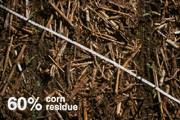
Very simply, every county has a designated route where information is visually captured from the road and recorded for later analysis. The routes generally travel throughout the main ag areas of the county. There are designated points, at regular intervals along the route where information is observed (typically this can be done from the road) and recorded. Information such as: current planted crop, previous crop, type of tillage used prior to planting-if any, and an estimated amount of residue (plant matter) remaining on the soil from the previously harvested crop (this is an indicator of soil erosion potential as bare soil can erode rapidly).

I know that this project may sound a little less than exciting, but the information is quite valuable. In fact, the Conservation Technology Information Center (CTIC) regularly requests this data to aggregate with other states’ data for tracking national cropland trends. In fact, the true value of this project may lie in the opportunity the transect presents for the key, local conservation experts to tour their county/area of responsibility together, discussing conservation planning solutions for observed environmental concerns (i.e. severe soil erosion, instances of impaired water resources) .

See our Conservation Tillage Program web page for more information and to see past Tillage Transect results!  To learn more about ways to improve soil health, improve profitability, and enhance your environmental stewardship....go to the Conservation Cropping Systems Initiative site.