Showing posts with label water quality. Show all posts

Monday, September 30, 2013

New Water Quality Trading Program reduces the amount of nutrients leaving the farm


Mark Thomas is an ISDA Soil Conservation Resource Specialist located in Southeastern Indiana.  He was raised and still works on his family farm raising corn, soybeans, beef cattle, and hay.  They have used No-till Planting for over twenty years.  Mark graduated from Purdue University in 1986 with a BS in Agriculture.  He has two children and is an adult 4H club leader.  He has been employed in Soil Conservation for 23 years and serves farmers in Franklin, Dearborn, Ohio, Switzerland, and Ripley Counties.


A pilot program between the Electric Power Research Institute and the State Agriculture Departments in Indiana, Ohio, and Kentucky launched in the summer of 2012.  The Ohio River Basin Trading Project is an interstate trading program that will allow power companies and farmers to work together to reduce nitrogen, phosphorus, and sediment runoff in the Ohio River Basin.  The five counties in Indiana that have been selected for this pilot program are Wayne, Dearborn, Ohio, Switzerland, and Ripley.
Farmers enter into contracts with their Soil and Water Conservation Districts to create water quality credits by installing Best Management Practices including Heavy Use Protection Areas, Hay Planting, and Cover Crops.  Several of these practices have been installed this summer. 


Another farmer has installed a Heavy Use Area Protection pad to help collect the nutrients   from a beef cattle feeding area.

For more information, contact the Indiana State Department of Agriculture.

Friday, April 13, 2012

The 4 R's - Nutrient Stewardship

If you have been paying attention to nutrient management in agriculture over the past few years then you have likely heard about "the 4 R's". 
Right fertilizer source at the..... Right rate, at the.... Right time and in the..... Right place.

State of the art devices help farmers to monitor nutrient applications.

This is a simple way that reminds us that appropriate utilization of nutrients such as nitrogen, phosphorus, and potassium is more complex than simply how many pounds per acre were applied.  Nutrient management can be a real challenge in agriculture, homeowners, golf courses, any type of entity managing open lands due to weather and climate fluctuations, soil variability, and environmental/social sensitivities.  


Soil nutrient needs are tested and mapped;
this aids with application recommendations.
This is a really important issue that is regularly misunderstood.  Nutrient management is complex and is difficult to summarize into simple soundbytes and requires years of experience to properly implement.  Let's take nitrogen for example, nitrogen changes molecular forms regularly in nature and some forms are what plants(corn, lawn grass, trees, etc.) want, some not; some forms of nitrogen turn into gas easily and simply become part of our air and many forms easily move whereever the water flows.  Tricky isn't it? 
So.....how efficiently nitrogen is utilized in nature, on your lawn, and in the farm field depends on your ability to predict the weather (meteorologist anyone?), determine if your vegetation/plants are/will be at a stage which they need nitrogen (agronomist/plant biochemist anyone?), and what form would be best to select for application based on those previous factors (yikes!).  Did I mention that nitrogen is expensive, so you really don't want to get this wrong or it will be painful on the pocketbook!  And of course an over-abundance nitrogen in our aquatic ecosystems can be detrimental in many ways too.  Lastly, in agriculture without the addition of vital nutrients, crop yields would be poor and declining, leading to serious food security concerns in the future.       
 
Here are more details about the 4 R's nutrient stewardship initiative:  The Fertilizer Institute (TFI) has been working collaboratively with the International Plant Nutrition Institute (IPNI), the International Fertilizer Industry Association and the Canadian Fertilizer Institute (CFI) to advance the 4R nutrient stewardship initiative. Two goals within the initiative include establishing 4Rs as a recognizable strategy for economic, social, and environmental sustainability and expanding the adoption of 4R nutrient stewardship as well as the awareness of these efforts to federal and state program officials.


Some conservation best management practices that Todd Welch, a 4 R's Advocate from Lafayette, IN utilizes on his farm to better ensure efficient use of nutrients.


• Utilize grid soil samples to create management zones
• Use manure nutrients from the hog operation to meet a fraction of fertilizer needs by applying to acres most in need of P and K
• Utilize Phytase in feed rations to improve phosphorus efficiency in the animal diet
• Utilize amendment to increase availability of P and K throughout the crop year
• Account for manure nutrients and adjust levels of commercial fertilizer to meet remainder of plants’ needs
• Utilize variable rate technology to apply commercial fertilizer
• Split apply nitrogen in fall and spring to reduce losses
• Incorporate nitrogen stabilizer with fall ammonia application to reduce losses
• Utilize in-season tissue sampling to obtain a snapshot of plant nutrient needs
• Utilize post-season stalk tests to evaluate nitrogen utilization
• Implement minimum tillage to help build and maintain organic residue
• Plant cover crops to generate organic matter, improve soil tilth, reduce compaction and improve
nitrogen management
• Enhance water management through utilization of waterways and tile control
• Install a precision planter system for better seed placement and spacing


What Todd says about the 4Rs: “Our farming operation firmly believes that the proper use of organic and commercial fertilizer is not only vital to our operation, but also economical and environmentally friendly to our natural resources”.

Tuesday, December 13, 2011

I Heart Soil


SSSA
I really do love soil and the folks that I work with in agriculture and conservation do too.  We love it because we have the opportunity to see everyday what a precious resource that it is.    We get to see the passion for conservation, productive lands, clean waters, wildlife, the Aldo Leopold "Land Ethic" in full swing!  In fact, everyone experiences the impact that soil has on our lives everyday through the food we eat, water we drink, home where we live, etc.  It is an awesome thing!

Another awesome thing.......the Soil Science Society of America has made these really cool, simple videos about the importance of healthy soil and the connection to clean water and food.  You can learn more at iheartsoil.org  .
Check out these cool videos by clicking the links below....I Heart Soil


Healthy Soil = Healthy Water
Healthy Soil = Healthy Food


Yet another awesome thing.......Our 2011 Indiana Tillage Transect results tell us that approximately 180,000 acres of Hoosier farmland is planted  to Cover Crops this year.  So, we have several farmers out there around Indiana working to build their soil quality, trying to hang on to their precious nutrients and topsoil, and keeping that beneficial soil biological activity humming all year long.  Good chance that if paired with no-till, they could be rewarded in any or all of the following....yield gains, better drought tolerance, minimized ponding, fuel savings, and on and on and on. 


Monday, June 27, 2011

No-till, Mulch-till, or Conventional-till Corn?

It may seem like a strange title, but this is the type of question that is being asked thousands of times all around our state in various counties right now. Conservation and agricultural professionals are asking specific questions, about very specific fields, which have had this type of information collected from them for over 20 years. We call it the Indiana Tillage Transect.


The Tillage Transect is a mechanism for tracking trends in conservation and cropland trends. The information collected can help us determine whether important soil quality building conservation activities, such as No-till, are being more heavily adopted or not. We can also take the collected data and estimate the average annual soil loss from Indiana’s agricultural lands. All of this information can help us to determine how to focus conservation efforts and resources in the future.

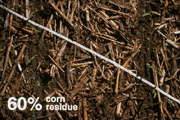
Very simply, every county has a designated route where information is visually captured from the road and recorded for later analysis. The routes generally travel throughout the main ag areas of the county. There are designated points, at regular intervals along the route where information is observed (typically this can be done from the road) and recorded. Information such as: current planted crop, previous crop, type of tillage used prior to planting-if any, and an estimated amount of residue (plant matter) remaining on the soil from the previously harvested crop (this is an indicator of soil erosion potential as bare soil can erode rapidly).

I know that this project may sound a little less than exciting, but the information is quite valuable. In fact, the Conservation Technology Information Center (CTIC) regularly requests this data to aggregate with other states’ data for tracking national cropland trends. In fact, the true value of this project may lie in the opportunity the transect presents for the key, local conservation experts to tour their county/area of responsibility together, discussing conservation planning solutions for observed environmental concerns (i.e. severe soil erosion, instances of impaired water resources) .

See our Conservation Tillage Program web page for more information and to see past Tillage Transect results!  To learn more about ways to improve soil health, improve profitability, and enhance your environmental stewardship....go to the Conservation Cropping Systems Initiative site.

Thursday, May 13, 2010

"Farm the Best and BUFFER the Rest!"

“Farm the Best and Buffer the Rest”

This snazzy little catch phrase has been used for the last several years to describe a suggested mentality when considering profitability and environmental stewardship on the farm. So, what do we mean by the best and what in the world is a buffer?

Farming “the best” simply suggests that we look at the potential profits for farming a piece of ground after subtracting the cost for fertilizer, seed, time, pesticide/herbicide, sustainability to continue farming that piece, and risk. The fact is there are portions of fields that are planted regularly at a loss of profit and there are options that exist, such as buffers, to minimize the losses.

Think of it like this…. Let’s say you want to plant a garden and you love growing sweet corn. You just moved to a new place with lots of trees and shade. You plant the sweet corn, but only a portion of the garden grows decent because part of it is too shady (all of it was probably eaten by raccoons anyway!) You decide to try the same next year. Same result – a partial crop of raccoon ravaged sweet corn! Wouldn’t it be a better decision to plant the sweet corn in the sunny spot and either don’t plant in the shade, or put in a shade tolerant crop, personally I would go with spinach (obvious reason for spinach - because it makes you strong like Popeye the Sailorman, enough said). But the point is that not all of the garden spot was the best for growing sweet corn and essentially you are wasting your seed, planting time, fertilizer, sore back from weeding, ammunition from trying hit raccoons(oops, I mean you’re tired from chasing them!), and many of these things represent wasted cash money.

Since gardens are somewhat of a hobby to many folks and not nearly the size of most fields, the losses are not such a big deal, however for a farmer whose livelihood relies upon growing quality food in an environmentally and economically sustainable way, this can be a big problem. Ideally every acre on the farm would be making money from the crops grown and harvested each season, so this is where careful planning and management of the farm are critical. We should be figuring all the costs associated with getting the crops in the ground and sold, but the tricky part is trying to best guess what Mother Nature will do as well to determine “The Best” acres.

Three examples where we may not be farming “The Best” :
1. Those low-lying fields which flood and delay planting or prevent harvest 3 out of 5 years need to be really profitable on the 2 good years to justify continued planting.
2. The edge of the field by the woods traditionally has low yields because the trees use up the moisture and the deer/raccoons just reach out and grab an easy meal, but typically the same amount of fertilizer is spent on that acre.
3. That area of the field is always wet, no matter how much tile is installed. The equipment gets stuck and it’s yielding poorly

So, this is where the phrase “Buffer the Rest” comes in to play(for the chemistry nuts we’re not talking about raising the pH/reducing acidity levels). Fields prone to flooding, wildlife damage, excessive doughtiness, excessive wetness, etc are all great candidates for the solution of “Buffers”. A buffer can be described as a vegetated or wetland area placed in the landscape for the purpose of protecting soil resources, improving air and water quality, or enhancing fish and wildlife habitat. Many times buffers or buffer strips are referred to as filter strips or field borders. The great thing about buffers is that, once they are established, the costs associated with seed, fertilizer, and labor are gone for that area. In addition to reduced costs, there are opportunities through federal programs, like the Conservation Reserve Program, to receive an annual payment for the land enrolled as buffer. Current regulations require minimum setbacks from surface waters for spraying pesticides/herbicides and a buffer provides an automatic potentially paid-for setback. A properly planned buffer can straighten up the edges of fields and make fields easier farm all while providing all of the above mentioned benefits. Many farmers enjoy buffers/field borders simply because of the easier access that this lane provides around the field for crop scouting or for activities like hunting.

As farmers carefully calculate their profit vs cost margins, the “Farm the Best, Buffer the Rest” concept should be seriously considered along with the role that buffers can play in the overall operation.