Showing posts with label environment. Show all posts

Monday, February 11, 2013

Fall Creek Watershed Partnership Activities and Updates

Post below was submitted by Leslie White of the Fall Creek Watershed Partnership. To have your Indiana conservation district/group news featured, please contact Jennifer at cleanwaterindiana@isda.in.gov. 


Fall Creek Watershed Partnership
Backyard Conservation Program
Planting Conservation Ideas and Practices in 2013

Backyard Conservation Coordinator Leslie White
Hi, I’m Leslie White, Fall Creek Watershed Partnership Backyard Conservation Coordinator working through the Soil & Water Conservation Districts of Hamilton, Hancock, Madison and Marion Counties. It’s my pleasure to share conservation information, address questions, offer suggestions and tailored conservation plans to help you reach your goals for your property. Feel free to email me at leslie-white@iaswcd.org or call 317-773-2181 to discuss conservation options and the financial assistance offered through several cost-share programs.


Monday, June 27, 2011

No-till, Mulch-till, or Conventional-till Corn?

It may seem like a strange title, but this is the type of question that is being asked thousands of times all around our state in various counties right now. Conservation and agricultural professionals are asking specific questions, about very specific fields, which have had this type of information collected from them for over 20 years. We call it the Indiana Tillage Transect.


The Tillage Transect is a mechanism for tracking trends in conservation and cropland trends. The information collected can help us determine whether important soil quality building conservation activities, such as No-till, are being more heavily adopted or not. We can also take the collected data and estimate the average annual soil loss from Indiana’s agricultural lands. All of this information can help us to determine how to focus conservation efforts and resources in the future.

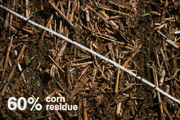
Very simply, every county has a designated route where information is visually captured from the road and recorded for later analysis. The routes generally travel throughout the main ag areas of the county. There are designated points, at regular intervals along the route where information is observed (typically this can be done from the road) and recorded. Information such as: current planted crop, previous crop, type of tillage used prior to planting-if any, and an estimated amount of residue (plant matter) remaining on the soil from the previously harvested crop (this is an indicator of soil erosion potential as bare soil can erode rapidly).

I know that this project may sound a little less than exciting, but the information is quite valuable. In fact, the Conservation Technology Information Center (CTIC) regularly requests this data to aggregate with other states’ data for tracking national cropland trends. In fact, the true value of this project may lie in the opportunity the transect presents for the key, local conservation experts to tour their county/area of responsibility together, discussing conservation planning solutions for observed environmental concerns (i.e. severe soil erosion, instances of impaired water resources) .

See our Conservation Tillage Program web page for more information and to see past Tillage Transect results!  To learn more about ways to improve soil health, improve profitability, and enhance your environmental stewardship....go to the Conservation Cropping Systems Initiative site.

Friday, January 21, 2011

How Do I Help The Environment?

I think deep down that most of us have that desire to leave this Earth a little better, ideally a lot better than we found it.  There are bunches of quotes out there that illustrate this desire and some can really connect with us in a deep way such as:
"We do not inherit the Earth from our Ancestors, we borrow it from our Children."

Well, if you feel compelled or pulled to pitch in and leave a lasting legacy to the betterment of our planet, I have the perfect idea.  Get involved with your local Soil and Water Conservation District.  It is so simple and it can really fulfill that little part of you that tugs and pulls for you to take some action.  That's what Soil and Water Conservation Districts are all about.......getting conservation practices that improve water quality, control soil erosion, and enhance wildlife habitat on the ground; it's their speciality. 

Each county in Indiana has a Soil and Water Conservation District (SWCD) that is lead by a board of supervisors.  They hold monthly public meetings and anyone can attend.  Individuals within the community serve as supervisors and they are elected or appointed, but there is plenty room for associate supervisors or volunteers to get involved.  SWCDs work with many conservation partners to hold demonstration field days, provide cost-share and incentives for conservation measures, perform education and outreach, and generally provide conservation assistance and advice to those looking to do right by the land.

This is an excellent time of year to check out your local SWCD at their Annual Meeting!  There is sure to be good food, educational/entertaining guests, and lots of information about the many programs and accomplishments of the district.

I know that time is limited, but serving on the Soil and Water Conservation District is absolutely the best way to make a positive impact on the environment in your local community!

Find contact information for your Soil and Water Conservation District at http://www.in.gov/isda/2408.htm  or you can look for the districts' individual websites at http://nacdnet.org/about/districts/directory/in.phtml#inweb

Wednesday, April 21, 2010

Earth Day, Everyday!

Earth Day, April 22, 2010 was really great for me this year! I tend to get pretty excited about Earth Day, it’s true. My friends and family think I'm crazy and there is no doubt that they are right about that, however for professionals who work in the environmental/conservation world, it's our day! I look at April 22nd, each year, as a day for reflection on my personal actions on the environment and I take a moment to really appreciate the work that is done on behalf of conserving our natural resources.

- First, Earth Day serves to remind us all to reflect on our own actions and the impact we, as individuals, are making on the environment. With new technologies and greening efforts there are many ways to minimize our environmental footprint with our everyday behaviors such as recycling, over or improper fertilizer application, wildlife habitat establishment or enhancement, and water/energy conservation. Over the years there have been some really interesting campaigns regarding environmental stewardship for the everyday citizen, such as this
poster with a guy fertilizing improperly and check out this video from our Indiana Department of Environmental Management. After all, Earth Day really is Everyday! My fellow ISDA blogger The Ag Grant Guru has is right this week, check out her blog!

- Second, Earth Day provides an excellent opportunity to show our appreciation for the many Hoosier conservation professionals, advocates, and partners who have spent years dedicated to the common purpose of making this planet a more ecologically sound/sustainable civilization. I can think of no better group to honor for this dedication than our own ISDA, Conservation staff. Our staff of just over 30 individuals do everything from working with farmers/landowners to install conservation practices on the land, to helping each of the 92 Soil and Water Conservation Districts effectively provide conservation services, to developing the very programs that encourage more and more protection of our precious natural resources. I can't begin to explain how proud I am to be to the director of such an important area and such a quality class of people who share my passion for conservation.
Kenny preaching soil conservation!
I had the opportunity on Earth Day to spend some time out in the field with one of our Resource Specialists, George Reger. We were mostly working with earthwork contractors who were busy constructing Grassed Waterways (designed swales in the field which alleviate gully erosion and minimize sediment/nutrient runoff). One of the contractors hard at work was Kenny "Cornfield" Cain. Kenny has been a great friend and advocate for conservation efforts and is well-known as a conservation farmer. Kenny took a few moments to discuss the current soil conditions with George and I along with the progress of corn planting in the area. It was a great day watching our conservation efforts coming to fruition right in front of us!

My thanks to George and Kenny for the great Earth Day! Thanks again to our Conservation staff and our supporters at the Indiana State Department of Agriculture!
Next week is Soil and Water Stewardship Week!!!